
Nestled atop the scenic Nilachal Hills in Guwahati, Assam, overlooking the mighty Brahmaputra River, the Kamakhya Temple stands as one of the most revered, mysterious, and ancient centers of Shakti worship in India. As the crown jewel among the 51 sacred Shakti Peethas, this ancient shrine draws millions of devout pilgrims, mystical sadhus, tantric practitioners, and curious travelers from around the globe every year.
If you are planning a spiritual journey to seek the divine blessings of Maa Kamakhya, understanding the meticulous daily schedule, ritual sequences, and crowd dynamics is absolutely essential. Navigating the heavy rush and matching your arrival with the official hours can transform an otherwise exhausting journey into a deeply peaceful, fulfilling, and transformative experience.
This comprehensive, highly detailed guide breaks down everything you need to know about kamakhya temple timings, daily darshan slots, specialized ritual hours, ticket structures, and critical local travel tips for a smooth, stress-free pilgrimage in 2026.
The Mystical Background of Maa Kamakhya Mandir

To truly appreciate why thousands of devotees stand in line for hours on end, one must understand the unique spiritual essence of this temple. Unlike standard Hindu temples where an idol or image of the deity is placed on a pedestal, the Garbhagriha (the core sanctum sanctorum) of the Maa Kamakhya Mandir contains no statue. Instead, it is a dark, subterranean stone cave reached by descending a flight of steep, damp rock steps.
Inside this natural cave lies a small sheet of bedrock featuring a natural cleft that resembles a yoni (the female creative organ). A perennial underground natural spring flows constantly over this fissure, keeping it moist and active. Devotees touch this sacred water, which is considered the fluid of life and creation, to receive blessings.
According to Puranic legends, when Lord Vishnu used his Sudarshana Chakra to dismantle the corpse of Goddess Sati to break Lord Shiva’s grief-induced dance of destruction (Tandava), her yoni-mandal (creative reproductive organ) fell precisely on the Nilachal Hills. Consequently, the site is venerated as the ultimate source of cosmic energy, feminine power, and fertility. Because of its profound cultural importance and structural limitations, the temple administration strictly regulates entry hours to allow the priests to complete age-old daily rituals without any modern disruptions.
General Kamakhya Temple Timings
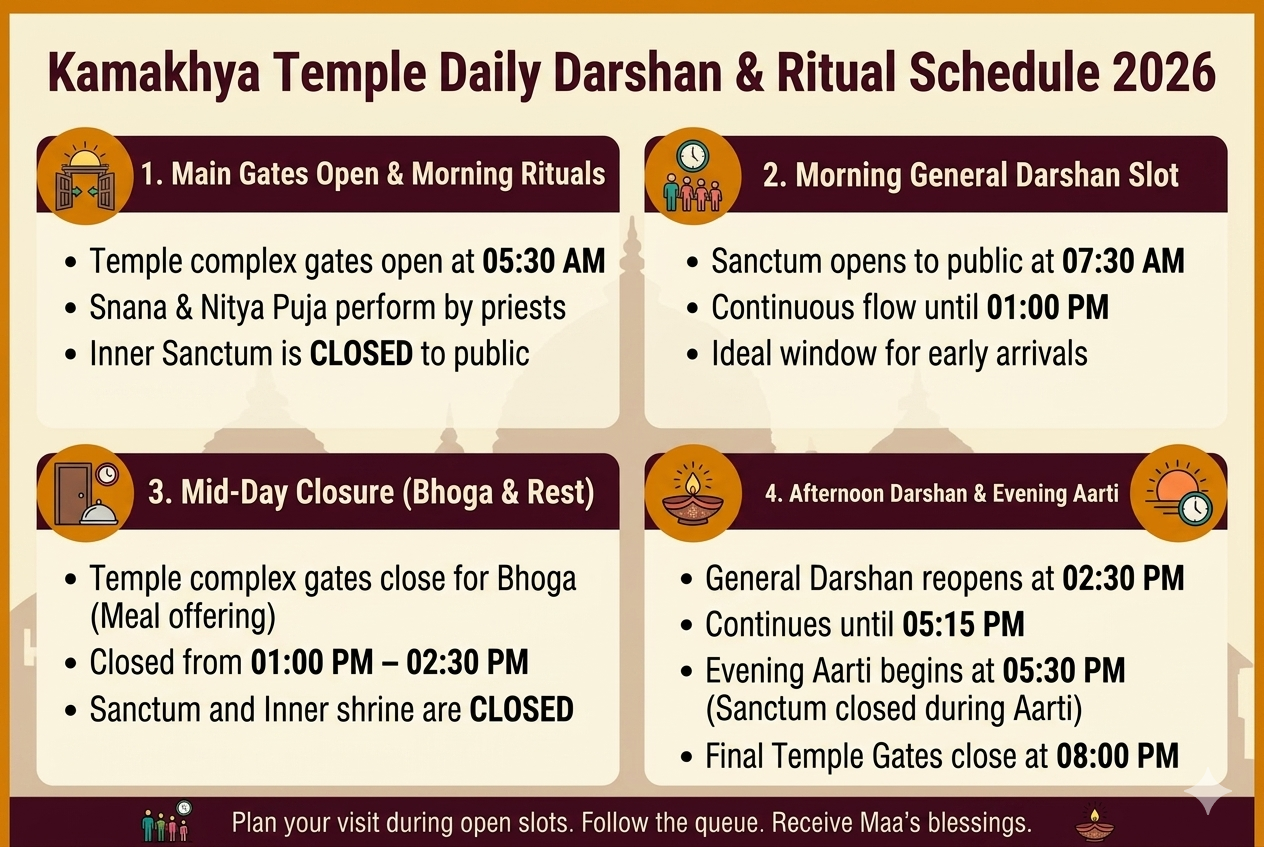
The daily operations of the temple follow a highly structured timeline managed by the Kamakhya Bordeuri Samaj—the traditional hereditary management board of priests. While the kamakhya temple opening time begins long before dawn, the innermost sanctum is not continuously open to the public throughout the day due to a sequence of private cleaning, bathing, and culinary offerings made to the Goddess.
The standard daily schedule for general devotees follows this timeline:
| Event / Activity | Standard Daily Timing | Inner Sanctum Access Status |
| Main Temple Gates Open | 05:30 AM | Closed to public (Courtyard open) |
| Snana & Nitya Puja Rituals | 05:30 AM – 07:30 AM | Closed to public for private rituals |
| Morning General Darshan | 07:30 AM – 01:00 PM | OPEN to all ticket holders |
| Temple Gates Close for Anna Bhoga | 01:00 PM – 02:30 PM | Closed to public for lunch & rest |
| Afternoon General Darshan | 02:30 PM – 05:15 PM | OPEN to all ticket holders |
| Evening Aarti & Scriptural Chanting | 05:30 PM – Sunset | Closed to public (Courtyard accessible) |
| Final Closure of Temple Complex | 08:00 PM | Entire complex closed for the night |
Daily Puja Rituals and Worship Procedures
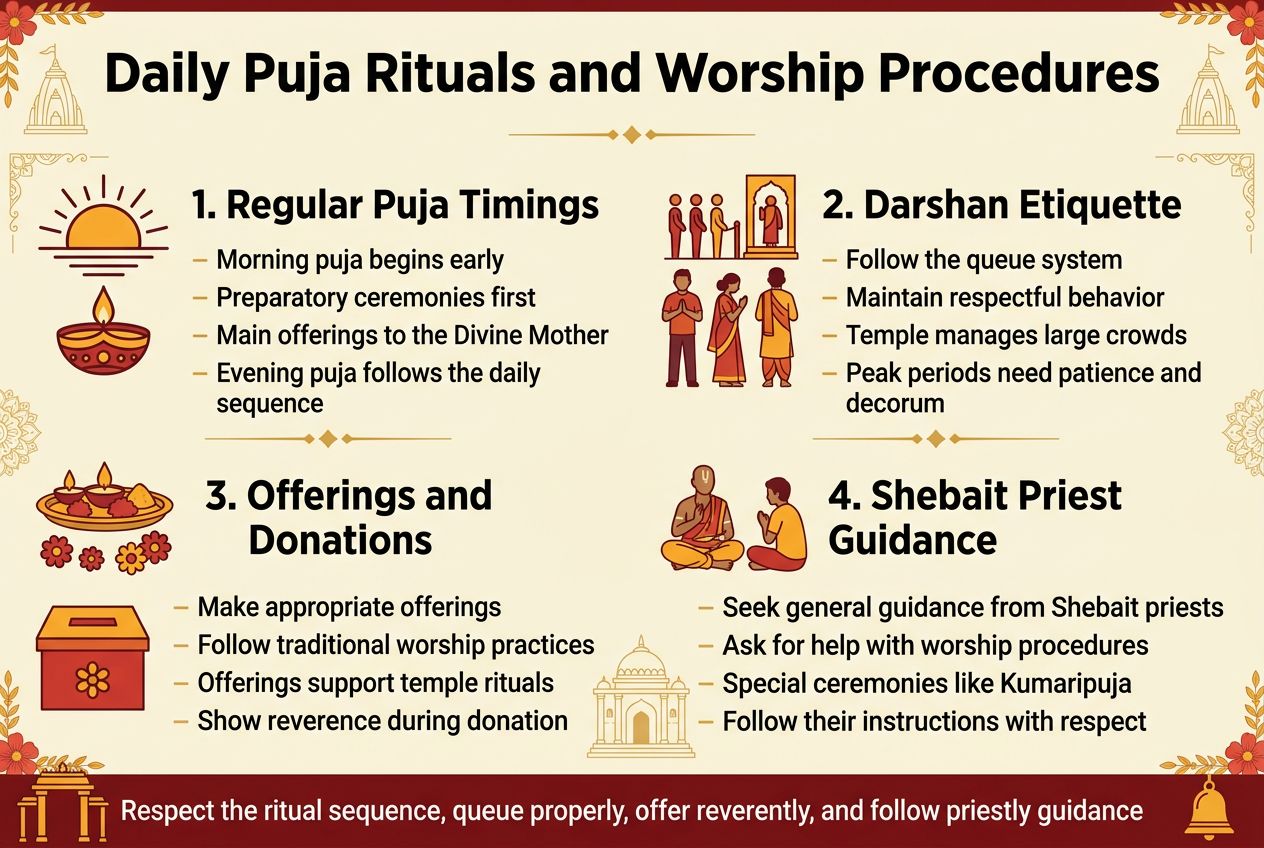
Regular Puja Timings and Sequences
The Kamakhya Temple follows a structured daily worship schedule that devotees should understand before visiting. The temple conducts regular morning and evening pujas as part of its daily rituals, which form the foundation of worship at this sacred complex. These Kamakhya Temple puja ceremonies follow traditional sequences that have been maintained for centuries.
The daily rituals begin early in the morning with preparatory ceremonies, followed by the main puja offerings to the Divine Mother. Understanding these Kamakhya Temple rituals helps devotees plan their visit effectively and participate meaningfully in the worship procedures.
Proper Darshan Etiquette and Queuing System
Thousands of devotees gather for darshan at Kamakhya Temple, especially after significant periods like the three-day closure during Ambubachi festival, when the temple reopens to receive blessings from the Divine Mother. The Kamakhya Temple worship procedures require devotees to maintain proper decorum while waiting in queues.
The darshan system is organized to ensure all visitors can have a meaningful spiritual experience. Devotees should follow the established queuing protocols and maintain respectful behavior throughout their visit. The temple management has implemented systematic procedures to handle large crowds, particularly during peak periods when thousands seek the Divine Mother’s blessings.
Detailed Step-by-Step Daily Routine of the Temple
To make sure you do not find yourself waiting outside locked gates, it helps to understand how a typical day unfolds step-by-step according to the official maa kamakhya mandir timings.
1. The Pre-Dawn Awakening and Cleansing (05:30 AM – 07:30 AM)
Long before the sun rises over the hills of Assam, the temple priests arrive at the complex. At 05:30 AM, the massive outer iron gates of the complex are opened. Devotees who have been waiting in line since the middle of the night can enter the stone courtyard.
However, the path to the inner cave is locked. During these first two hours, the head priests perform Snana—the ritual bathing of the sacred bedrock using milk, honey, ghee, curd, and holy river water. This is immediately followed by the Nitya Puja, a private daily worship ceremony accompanied by internal chants and seed mantras.
2. The Morning Darshan Rush (07:30 AM – 01:00 PM)
At approximately 07:30 AM, the heavy doors leading down to the Garbhagriha are thrown open. The massive queue of pilgrims begins moving through the decorated corridors. This is the longest continuous slot available for public darshan during the day. It is highly active, vibrant, and filled with devotional chants of “Jai Maa Kamakhya” echoing through the historic stone halls.
3. The Mid-Day Sacred Feast and Rest (01:00 PM – 02:30 PM)
As midday approaches, the doors to the inner sanctum are closed precisely at 01:00 PM. The priests prepare the Anna Bhoga—a sacred meal consisting of cooked rice, lentils, seasonal vegetables, and meat offerings prepared traditionally in the temple kitchen. The deity is symbolically fed, and the inner chambers are cleaned.
This serves as a rest period for the inner shrine. While you cannot enter the cave during this hour and a half, you are free to sit in the open-air pavilions, explore the stunning external rock carvings, or grab lunch at the local eateries located on the hill.
4. The Afternoon Darshan Window (02:30 PM – 05:15 PM)
At 02:30 PM, the doors open for the second public phase of the day. This window is typically faster-moving but shorter. If you are in line during this phase, pay close attention to the time, as the entry queue to the main waiting hall is often cut off by 04:30 PM to ensure that everyone already inside can reach the shrine before the evening closure.
5. The Evening Aarti and Complete Lock-up (05:30 PM Onwards)
As twilight sets over Nilachal Hill, the afternoon session winds down at 05:15 PM. By 05:30 PM, the grand Sandhya Aarti (evening prayer) begins. The atmosphere becomes electric as monumental brass lamps are lit, large incense burners fill the air with thick fragrant smoke, and traditional drums (Dhols), conch shells, and large bronze bells resonate across the entire hilltop.
Devotees can stand in the courtyard to witness the light and sound of the evening prayer, but no one is allowed down into the cave. After the aarti concludes, the priests perform the final closing rituals, lock the inner sanctum, and by 08:00 PM, the entire outer complex is cleared and closed to secure the premises until the next morning.
The Geometry of the Queues: Ticket Types and Waiting Realities
The waiting time at Kamakhya Temple is a major factor that every traveler must anticipate. Because the actual path down into the cave is narrow and forces people to move in a single-file line down old stone steps, a natural bottleneck forms. Depending on which queue you choose, your waiting experience will vary dramatically.
The General Line (Free of Charge)
Cost: Absolutely free.
The Experience: You enter through a sequence of massive, covered holding cages called Sukanath. These halls are equipped with basic seating benches, overhead fans, and drinking water outlets.
The Wait Time: On average mid-week days (Tuesday through Thursday), the wait time is between 3 to 5 hours. On weekends (Saturday and Sunday), Mondays (considered auspicious for Shiva-Shakti), or during lunar phases like Ashtami and Navami, the wait time can easily skyrocket to 6 to 10 hours.
The Special / VIP Darshan Line
Cost: ₹501 per ticket.
The Experience: This ticket can be purchased directly from the authorized ticket counters managed by the temple board at the hilltop complex. It grants you access to a separate, accelerated corridor that bypasses the bulk of the general crowd holding areas.
The Wait Time: While it is called a “VIP” line, the sheer volume of travelers purchasing this pass means it is rarely instantaneous. Expect a waiting time of 1 to 3 hours even with this pass, though it provides a significantly more shielded and manageable environment.
Architectural and Spiritual Composition of the Hilltop
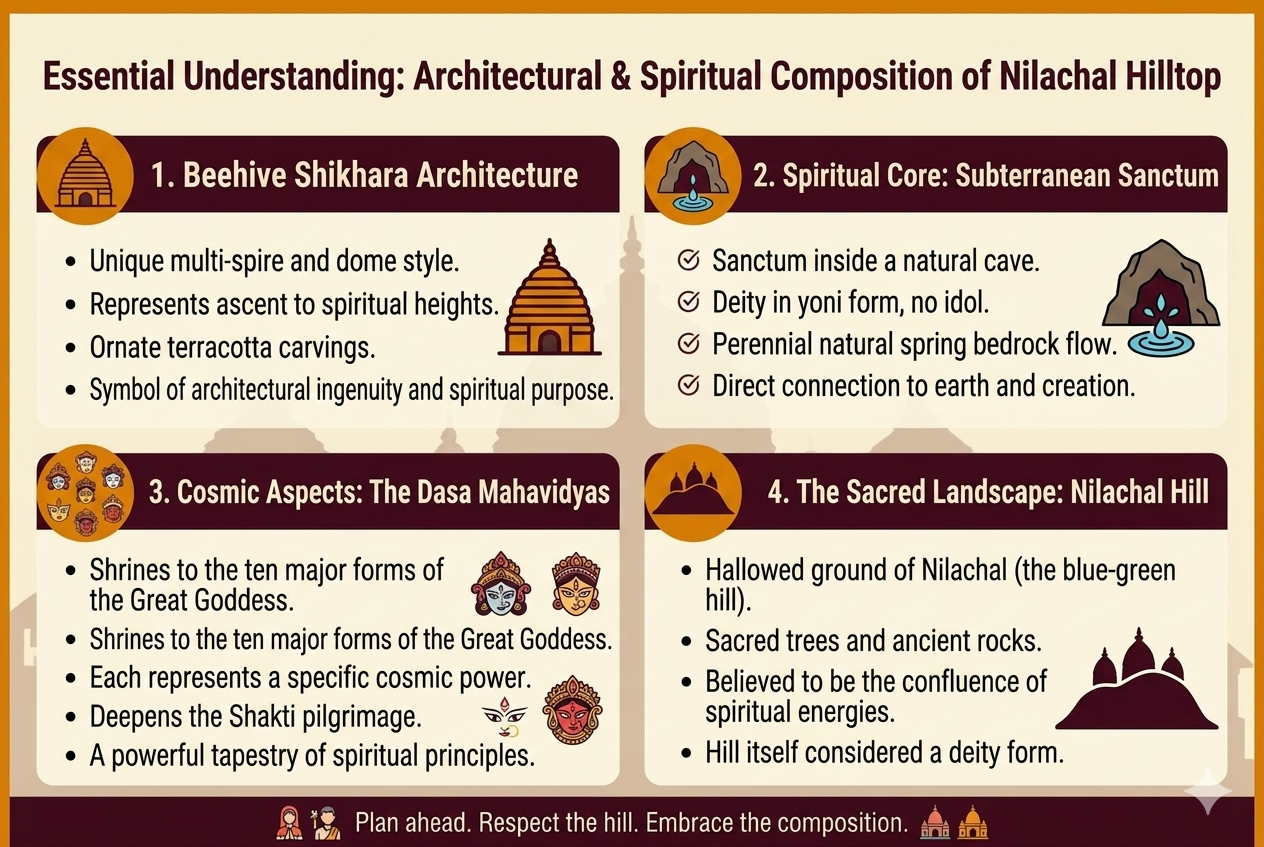
If you have a long wait time due to the afternoon closure, you do not have to leave the hill. The Nilachal Hill complex is a sprawling spiritual ecosystem containing several peripheral shrines dedicated to the Dasa Mahavidyas (the ten distinct cosmic aspects of the Mahadevi or Great Goddess).
Visiting these surrounding structures provides a complete picture of the Tantric landscape of Assam:
Tara Temple: Located slightly lower on the hill, dedicated to Goddess Tara, another major Mahavidya.
Bhubaneswari Temple: Perched at the highest peak of the Nilachal hill range, offering an panoramic, breathtaking aerial view of the Brahmaputra River cutting through Guwahati city.
Bagalamukhi, Chinnamasta, and Bhairavi Shrines: These smaller historical structures are scattered around the main temple perimeter and hold massive significance for esoteric sadhanas and quiet meditation away from the main public rush.
Practical Checklist for Devotees Visiting in 2026
To prevent administrative friction or physical discomfort during your pilgrimage, weave these professional recommendations into your travel planning:
Best Times of the Year to Travel
The ideal months to visit Kamakhya Temple are between October and March. During this autumn and winter window, the weather in Assam is pleasantly cool, breezy, and completely devoid of the intense monsoon rains that can make walking up the hill paths slippery and humid.
Avoid mid-June if you do not want to encounter massive, overwhelming crowds, as that is when the Ambubachi Mela brings nearly a million sadhus and pilgrims to the site, closing the main sanctum for three full days.
Strict Dress Codes and Cultural Etiquette
The temple board emphasizes modesty and clean presentation. While there is no strict mandate forcing men to wear silk veshtis, traditional Indian wear is highly recommended:
For Women: Sarees, elegant salwar suits, or traditional Assamese Mekhela Chadors are highly preferred. Avoid crop tops, shorts, or ripped jeans.
For Men: Kurtas, pyjamas, dhotis, or standard full-length trousers are appropriate. Shorts or sleeveless shirts are frowned upon and may result in security guards turning you away at the main entrance gate.
Managing Footwear and Personal Items
No footwear is allowed anywhere inside the main stone courtyard of the temple. Do not leave your shoes randomly on the steps; instead, use the authorized footwear storage counters situated near the main entrance gates. They operate on a secure token system for a very minor nominal fee.
Similarly, leather items like belts, heavy wallets, or large backpacks should ideally be left in your hotel room or vehicle to simplify your passage through the metal detectors at the security checkpoint.
Photography and Electronics Restrictions
You are free to take beautiful photographs of the outer architecture, the unique beehive-shaped shikhara roofs, and the scenic mountain backdrops from the courtyard. However, carrying cameras, video equipment, or using smartphones inside the dark inner cave (Garbhagriha) is an absolute legal offense. Turn off your mobile phones or keep them securely inside your pocket before you begin descending the steps into the inner sanctum.
Navigating the Internal Cave Safely
The inner shrine is a dark, humid, natural cave. The steps leading down are cut out of natural stone and can be slick from the natural moisture of the subterranean spring and the wet hands of thousands of preceding pilgrims. Walk slowly, hold onto the metal guide rails provided along the walls, and follow the instructions of the volunteers moving the line along. If you are traveling with toddlers or elderly relatives, keep them close and maintain a steady, cautious footing.
Comprehensive Transit Guide: How to Get to Nilachal Hill

Guwahati is widely recognized as the commercial and logistical gateway to Northeast India, making a journey to the Kamakhya Temple highly accessible through multiple modes of transportation.
By Air
The Lokpriya Gopinath Bordoloi International Airport (GAU) in Guwahati is located approximately 20 kilometers away from the temple site. The airport is exceptionally well-connected with daily direct flights from major metropolitan hubs like New Delhi, Mumbai, Kolkata, Bengaluru, and Hyderabad. From the arrival terminal, you can easily hire pre-paid airport taxis or book app-based rides (like Ola or Uber) to drive you directly to the top of Nilachal Hill.
By Rail
There are two primary railway options available:
Kamakhya Railway Junction (KYQ): This is a smaller station located right at the foot of the Nilachal hill range. Many long-distance trains stop here. If your train halts at this junction, it is your most convenient point of disembarkation, as you are only a short 10-minute auto-rickshaw or taxi drive away from the main temple ascent road.
Guwahati Railway Station (GHY): Located in the heart of the city, roughly 8 kilometers away from the temple complex. It handles a larger volume of interstate trains and provides extensive options for vehicle rentals and local city bus connections.
By Road and Hill Ascent
Once you reach the base of the hill (known locally as the Kamakhya Gate on the Assam Trunk Road), you have two choices to reach the top parking lot:
By Vehicle: A smooth, well-maintained, multi-lane winding pitch road runs from the base gate to the hilltop. You can take your private car, hire an automated shared shuttle car for a small cash fare per seat, or use local auto-rickshaws.
By Foot (The Pilgrim Trail): For those who wish to experience the pilgrimage traditionally, there are ancient stone stairs called the Mekhela Uja Path that cut vertically up the hillside through dense green trees. It is a steep, physically demanding climb of about 1.5 kilometers that takes roughly 30 to 45 minutes of steady trekking.
By keeping these comprehensive kamakhya temple timings and navigational guidelines clear in your mind, your journey up the mystical hills of Assam will be seamless, structured, and profoundly memorable. Plan ahead, arrive early, and enjoy the ancient spiritual energy of Maa Kamakhya.